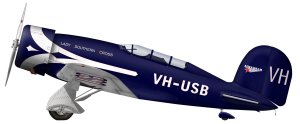
VH-USB Lady Southern Cross (Part 3)
 |
| Link to Part 1 | 118W | Sirius Times (pre-Smithy) |
| Link to Part 2 | VH-USB | On to the Australian Register |
| This is Part 3 | VH-USB | The Air Race and the Pacific Flight |
| Link to Part 4 | G-ADUS | On to the British Register |
Type: Altair 8D Special
MSN: 152
Identities:
| NR118W | Sirius 8A | Hutchinson |
| NC118W | Sirius 8 Special | Fleming |
| X118W | Altair 8D Special | Kingsford Smith |
| VH-USB | Altair 8D Special | Kingsford Smith |
| G-ADUS | Altair 8D Special | Kingsford Smith |
History:
|
29SEP34
|
Smithy and P.G. Taylor departed Sydney in the Altair on their way to London to compete in the Centenary Air Race. The aircraft landed at Charleville for fuel before continuing to Cloncurry. Although Smithy was hoping to reach Darwin in one day, they were delayed by a dust storm at Cloncurry where they stayed overnight. Also passing through Cloncurry was the famous Fokker FVIIB-3m VH-USU Southern Cross which was being flown on a geological survey by Harry Purvis, who was also a skilled engineer. Smithy asked Harry Purvis to check the Altair's engine and during his examination he discovered that the cowling was cracking at many of the rivet holes. Consequently, it was decided that they must return to Sydney for repairs. | ||||||||||
|
30SEP34
|
The Altair departed Cloncurry for Sydney but was again delayed overnight by a dust storm, this time at Roma. Newspaper reports stated that "he is taking the precaution of landing at nearly every aerodrome on the way for a few minutes to examine the cowling." It was also reported that the Altair was "compelled to loaf along at a mere 125 miles an hour." Recorded stops were Blackall and Charleville. | ||||||||||
|
01OCT34
|
The Altair departed Roma for Archerfield (Brisbane). As the condition of the cowling had not deteriorated on the trip from Roma, Smithy decided to fly non-stop from Brisbane to Sydney. On arrival in Sydney, the damaged cowling was immediately removed and taken to the workshop of Messrs Holder and Stroud where it was used to make a former for the new cowling. Commenting on the cracks to the cowling, Wing Commander Wackett (aeronautical engineer and adviser to Smithy) was quoted in the press as saying: "This is obviously a case of fatigue. It did not happen in Queensland, but has been working up for some time. After all, the plane has done a good deal of work lately." The cowling was also found to have a large dent in the underside and this was attributed to a possible birdstrike. Some press reports stated that the replacement cowling was being made from steel but this is probably attributable to problems encountered with replacement attachment brackets which were ultimately fabricated from steel by Wackett and Tommy Pethybridge. | ||||||||||
|
02OCT34
|
Newspaper reports stated that Smithy had decided to postpone his departure until the morning of Thursday 4th October owing to ongoing difficulties with the replacement cowling. Newspaper reports also stated: "The repairs effected to the plane were a triumph for Australian engineering. It was the biggest job ever undertaken by the firm, and the expedition with which the work was handled was a subject of favourable comment by the aviator." | ||||||||||
|
03OCT34
|
Although
Holder and Stroud had engaged additional staff and worked around the
clock to repair the cowling, it became apparent that the work would
not be completed in time for the Altair to reach England by the race
deadline and Smithy sent the following telegram to the secretary of
the Race Committee in Melbourne: "Deeply regret, account delays and difficulties completing job, unable participate Centenary Air Race. Please accept this as formal withdrawal, coupled with sincerest good wishes for winner and safe carrying-out of most spectacular air race in history of aviation." Although there was speculation that Smithy might be granted a dispensation from the October 14 race deadline, the reality of the task facing him, as reported in the press, was that he must:
| ||||||||||
|
03OCT34
|
Smithy
sent the following telegram to Civil Aviation in Melbourne: "In spite terrific endeavours impossible complete job in time participate race stop Deeply regret wasted trouble and appreciate departmental efforts to facilitate my previous plans stop Will appreciate few weeks extension time machine allowed Australia until decision made as to disposal of same." | ||||||||||
|
04OCT34
|
The
District Superintendent of Civil Aviation sent the following message
to the Controller of Civil Aviation: "Reference VH USB Customs Branch Sydney advises that Kingsford Smith should apply that branch for permission retain machine this country after 16th October. Customs Branch will probably ask views of this branch re airworthiness certificate." | ||||||||||
|
05OCT34
|
Civil
Aviation, Melbourne sent the following telegram to Smithy: "Very much regret hear you unable participate air race and appreciate your thanks departmental efforts stop Question extension time machine allowed Australia should be taken up direct with Customs." | ||||||||||
|
05OCT34
|
It
was announced in a Sydney newspaper that Smithy was planning to fly
the Altair across the Pacific Ocean from Australia to the United States
where he planned to sell it in order to repay his backers. The flight
was also intended as a face-saving exercise, although advice from
the Australian authorities that the Altair's special category CofA
would be revoked was another factor. For this flight, additional long
range tanks were designed and installed by the noted Australian aeronautical
engineer Lawrence Wackett (later Sir Lawrence). Analysis of the Fuel Tanks Quotes from P.G. Taylor's book | ||||||||||
|
09OCT34
|
The
Controller of Civil Aviation sent the following message to the District
Superintendent, Mascot: "Signal immediately available details extra tankage weights etc. proposed for Pacific flight USB." The reply from DSCA was sent on 10th October 1934 and can be viewed here. | ||||||||||
|
11OCT34
|
Tommy Pethybridge with John and Beris Stannage departed Sydney for Fiji on the Aorangi. | ||||||||||
|
18OCT34
|
The aircraft was test flown at Mascot to determine fuel consumption after the fitment of additional tanks. | ||||||||||
|
19OCT34
|
Smithy and P.G. Taylor departed Sydney "shortly after noon" for Archerfield, Brisbane "a little over three hours later". After arrival at Archerfield it emerged that the planned long range power setting (1700rpm) was producing excessive fuel consumption. Under these circumstances the Altair would not have the range for the Fiji to Honolulu leg. Departure for Fiji was postponed pending further testing. | ||||||||||
|
20OCT34
|
A test flight from Archerfield over Moreton Bay revealed that a power setting of 1600rpm produced the desired range. | ||||||||||
|
21OCT34
|
The Altair departed Archerfield, Brisbane at 0403 local (1803 GMT) for Suva, Fiji flown by Smithy with P.G. Taylor as navigator and co-pilot. The aircraft landed in Albert Park, Suva at 1805 local (0605 GMT). | ||||||||||
|
24OCT34
|
The Altair was ferried from Albert Park to Naselai Beach where a longer takeoff run was available. | ||||||||||
|
24OCT34
|
Takeoff from Naselai Beach was aborted when a crosswind forced the aircraft into the water. The aeroplane was recovered to higher ground without damage to await improved conditions. | ||||||||||
|
26OCT34
|
John and Beris Stannage arrived in Honolulu from Auckland on the Aorangi. Beris Stannage was Smithy's niece. | ||||||||||
|
29OCT34
|
The aircraft departed Naselai Beach for Hawaii at 0608 local (1808 28OCT GMT). While cruising at 15,000 feet in heavy rain and turbulence, the Altair entered a spin from which it was not recovered until 6,000 feet. While still struggling to maintain altitude at full throttle, Smithy discovered what had caused the sudden loss of control. To assess the strength of the rain, which it was feared might be eroding the leading edge of the wooden wing, Smithy had been periodically turning on the landing lights and in so doing he had apparently inadvertently moved the switch for lowering the flaps. (See 20DEC34 - Lockheed Repair Order #217). The Altair landed at Wheeler Field on Monday 29OCT34 at 0840 local (1910 GMT) becoming the first foreign registered aircraft to land in Hawaii. Note: the International Date Line was crossed between Fiji and Hawaii. P.G. Taylor does not record the arrival time in Pacific Flight. This time is derived from contemporary press reports. | ||||||||||
|
29OCT34
|
John and Beris Stannage departed for San Francisco on the Monterey. | ||||||||||
|
30OCT34
|
During a short flight from Wheeler Field, it emerged that there was a leak in the fuel system. Indeed, the Altair had to be refuelled before it could taxy in after landing! Although the leak was traced to the twenty gallon tank under the pilot's seat, it was decided to bypass the tank as it would not be required for the comparatively short hop to the mainland. However, a subsequent investigation by USAAC engineers also disclosed a crack in the oil tank. In lifting the fuselage from the wing to gain access, it was furthermore discovered that the main fuel tank had been chafing on a bolt head which had worn part of the tank paper thin. Repairs were completed to the highest standards by the USAAC engineers at no cost. This drew much praise from Smithy and Taylor. | ||||||||||
|
31OCT34
|
Smithy received a radiogram from Bud Morriss in Los Angeles warning him that a person believed to be Thomas Catton might attempt to attach a lien to the Altair on arrival. Morriss advised that this was the reason for an earlier suggestion that the flight operate to Los Angeles in lieu of Oakland. See 05NOV34 and 09NOV34. | ||||||||||
|
03NOV34
|
Prior to departure from Wheeler Field, P.G. Taylor visited Commander Bayliss on the USCGC Itasca to synchronise his chronometer. Departed from Wheeler Field, Hawaii at 1415 local (0015 GMT). P.G. Taylor does not record the departure time in Pacific Flight. This time is derived from contemporary press reports. | ||||||||||
|
04NOV34
|
Arrived Oakland, California at 0740 local time (1540 GMT). (Source 12 quotes the arrival time at Oakland as 0748). In his book Pacific Flight, P.G. Taylor records that he and Smithy returned to Oakland Airport by car at about noon and arrived in the Los Angeles area "an hour and a half after leaving Oakland". (Source 12 quotes the departure time from Oakland as 1317 local 2117 GMT). P.G. Taylor goes on to state; "We glide over the open country towards the aerodrome, and the Altair floats above the land of the factory where she was built." This clearly implies Burbank but further research reveals that the aircraft actually landed at Los Angeles Municipal Airport (formerly Mines Field) at Inglewood, California. Press reports indicate that Smithy did some local flying before the aircraft was returned to Lockheed at Burbank for maintenance. P.G. Taylor departed for Newark by airline on 06NOV34 so he could not have been on the aircraft when it was delivered to Lockheed. Contemporary press reports show that they arrived Los Angeles at 1525 local (2325 GMT) "after a two hour flight from Oakland". Local press reported that, while they were in Oakland, Smithy and Taylor rested at the home of Smithy's brother Harold Kingsford Smith. On departure from Oakland they were farewelled by Harry Lyon and Jim Warner. | ||||||||||
|
04NOV34
|
The Daily News (Los Angeles) of 05NOV34 reported: "Chipper and apparently unfatigued, Sir Charles Kingsford-Smith landed the Lady Southern Cross at Mines Field at 3:24 p.m. yesterday to complete the last lap of his trans-Pacific flight from Melbourne (sic) Australia. Escorted by three navy planes, Sir Charles dipped low in a preliminary swoop over the assembled crowd, circled and then brought the monoplane leisurely to a halt before the stand erected for welcoming ceremonies." | ||||||||||
| Schedule of the Pacific Flight | |||||||||||
|
05NOV34
|
The Oakland Tribune reported that CKS would be returning to Oakland from Los Angeles to lead the Oakland Armistice Day Parade on 12NOV34 as Honorary Grand Marshal. (Source: 13) | ||||||||||
|
05NOV34
|
A
United Press Association report from Los Angeles on this date stated;
"Sir Charles Kingsford Smith's monoplane Lady Southern Cross
was to-day attached in a suit filed by E. Beverly, assignee of Tom
Catton, who asserted that the flier owed him 27,050 dollars for interest
and services rendered in 1928, preparatory to Sir Charles' westward
flight to Brisbane. Under the California laws it is necessary for
Sir Charles to post a 25,000 dollars bond to obtain release of the
machine, which is now in the possession of the Deputy-Marshal."
The Santa Cruz Sentinel of 06NOV34 reported that on 05NOV34; "Deputy City Marshal Jerry Wenger took charge of the airplane, and seated himself, legs crossed and chair cocked back against the hangar wall, where he could keep his eye on it." The Daily News (Los Angeles) of 06NOV34 reported: "Sir Charles' financial worries were tempered yesterday by honors which the city showered on him. He was guest of honor at a banquet held last night at the Clark hotel under the sponsorship of the Chamber of Commerce and the Junior Chamber of Commerce. This morning he will be a guest of the Breakfast club, and of Chief of Police James E. Davis at the police pistol range. Like Black Beauty who lost her master, the Lady Southern Cross is in custody of a stranger today - Joe Wilson, watchman at the Municipal Airport, who was designated keeper of the plane by court order." (Source: 13) | ||||||||||
|
06NOV34
|
Associated Press reported from Oakland on this date:
| ||||||||||
|
06NOV34
|
The
Daily News (LA) reported that P.G. Taylor departed Los Angeles
for Newark in a Douglas airliner. He subsequently travelled to London
by sea. (Source: 13) Newspaper photographs depict P.G. Taylor disembarking from a TWA DC-2 at Newark on 07NOV34. | ||||||||||
|
07NOV34
|
The San Pedro News Pilot reported that two Grace Line executives flew with CKS in a one hour flight over Los Angeles during which CKS handled the controls of the Rickenbacker aircraft. (Source: 13) | ||||||||||
|
07NOV34
|
The San Bernardino Sun reported that CKS was planning to sell the Altair to raise $30,000 to repay his backers. (Source: 13) | ||||||||||
|
08NOV34
|
The San Pedro News Pilot reported that CKS had received a flood of offers to fly, to go on lecture tours and to appear in movies. CKS attorney was completing a cross complaint to the Catton suit. (Source: 13) | ||||||||||
|
09NOV34
|
A United Press Association report from Los Angeles on this date stated; "Mr Thomas Catton's suit against the Lady Southern Cross was settled out of court to-day for what Mr Catton's attorneys said was a satisfactory sum, but which Kingsford Smith's lawyer, Mr Leo Goodman, termed a nominal sum." (Source: 13) | ||||||||||
|
09NOV34
|
The Press Democrat, Santa Rosa, CA reported that CKS would celebrate the lifting of the legal attachment on the Altair "by taking a number of film colony acquaintances, including Myrna Loy and Mary Walker, for flights in the blue, low winged racer." (Source: 13) | ||||||||||
|
09NOV34
|
The San Pedro New Pilot reported that CKS was a guest of Capt Allan Hancock on board his yacht. (Source: 13) | ||||||||||
|
10NOV34
|
The Oakland Tribune reported that a big welcome was planned for Sir Charles in Oakland and that the Altair would have a guard of honour by Legionnaires. CKS would give a press conference at the airport and meet with business associates. (Source: 13) | ||||||||||
|
11NOV34
|
Smithy flew the Altair from Los Angeles to Oakland arriving at 10:20am after a flight of 1:59, with an unnamed passenger, for Armistice Day commemorations. (Source: 12) | ||||||||||
|
11NOV34
|
The Oakland Tribune reported that on arrival from Los Angeles CKS would be presented with a scroll making him an adopted member of Bill Erwin Post of the American Legion. (Source: 13) | ||||||||||
|
12NOV34
|
The Oakland Tribune reported that: "Sir Charles Kingsford Smith Leads March of Military and Naval Units through Oakland Streets. For five minutes Oakland's busiest streets were as still as was the Argonne Forest after the soldiers left and before the birds came back. The flags of the marching units stirred lazily upon motionless staffs, a thick morning fog dimmed the brightness of a thousand motionless bayonets. Far off, down at Lakeside Park, came at intervals the muffled booms of a 21-gun salute. The long parade headed by Sir Charles Kingsford Smith observed a five minute period of respectful silence." (Source: 13) | ||||||||||
|
13NOV34
|
The
Press Democrat reported that the USN dirigible USS Macon,
based at Sunnyvale, had soared over the procession led by Sir Charles
Kingsford Smith. (Source: 13) Just three months later, the USS Macon (ZRS-5) crashed into the sea off the coast of California. (Source: Wikipedia) | ||||||||||
|
13NOV34
|
The Oakland Tribune reported under the headline: "Sir Charles Prepares to Sell Plane" that he was planning to go to New York to negotiate with sponsors for a London-Melbourne flight. At a luncheon at Hotel Oakland after the Armistice Day Parade, CKS was gifted a pair of silver candle sticks and a silver bowl of a similar pattern to the silver service which was presented to him in 1930 after the global circumnavigation flight. The presentation was made by the Oakland Junior Chamber of Commerce who also provided a gold watch for later presentation to P.G. Taylor by CKS. (Source: 13) | ||||||||||
|
13NOV34
|
Smithy
departed Oakland in the Altair for Los Angeles, Mines at 3:20pm with
one passenger. (Source: 12) The Imperial Valley Press reported the flight duration as 1:57. (Source: 13) | ||||||||||
|
13NOV34
|
The Daily News (LA) quoted CKS as saying: "I will fly the Lady Southern Cross back to Burbank tonight for an overhaulling. I will then return to Oakland and will know by Nov 15th of flight plans." (Source: 13) | ||||||||||
|
14NOV34
|
A
Lockheed IDC from Carl B. Squier to the Factory stated: "Please run a thorough inspection on this ship, with special emphasis on the landing gear, cowling, tank installation, etc. Two new tires are coming from Mines Field on the Electra. Please see that these are installed on the above ship. Place the two tires removed, and all other personal belongings of Sir Charles, tagged in his name, in the stock room." | ||||||||||
|
16NOV34
|
The Imperial Valley Press reported that CKS arrived in Oakland from Los Angeles on 15DEC34 on a United Air Lines aircraft and visited his brother Harold. (Source: 13) | ||||||||||
|
16NOV34
|
The Oakland Tribune reported that CKS would be a guest of honour at the annual meeting of the Last Man Club of Alameda County at San Lorenzo. (Source: 13) | ||||||||||
|
22NOV34
|
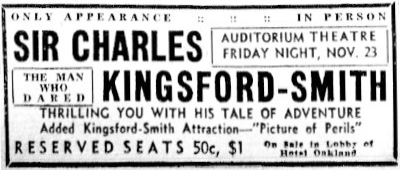
The Oakland Tribune reported that CKS had signed with Ralph Pincus and Herbert Rosener for his first US public lecture talk at Auditorium Theatre which will be augmented by the Charles Kingsford Smith movie The Picture of Perils. (Source: 13)
(Source: 13, Oakland Tribune on several days leading up to the lecture) | ||||||||||
|
24NOV34
|
The Oakland Tribune reported that a lecture at the Oakland Auditorium on 23DEC34 had been cancelled because of poor patronage. CKS flew back to Los Angeles with immediate concern to secure financial backing for plans. (Source: 13) | ||||||||||
|
29NOV34
|
The Oakland Tribune reported: "Sir Charles to Fly Home or Get a Job". CKS was guest of honour at the Commercial Club Dinner on 28NOV34. (Source: 13) | ||||||||||
|
06DEC34
|
In his column in the San Bernardino Sun, Will Rogers reported that he had lunch with CKS in the studio cafe on 04DEC34. (Photo) During lunch, CKS was called to the telephone to be told that Charles Ulm was missing on a flight to Hawaii. (Source: 13) | ||||||||||
|
06DEC34
|
The Oakland Tribune reported: "Sir Charles Has High Hopes Ulm is Alive". The Lady Southen Cross is being overhauled at the Lockheed plant and could not be ready for the air before another week. (Source: 13) | ||||||||||
|
07DEC34
|
The Oakland Tribune reported under the headline: "Sir Charles Claims Ulm, Crew Alive" CKS arrived in Oakland from Los Angeles to urge continuation of the search for Ulm's Airspeed Envoy and expressing a desire to join the search; "but I have no navigator right now and my plane isn't in any condition to take to the air." (Source: 13) | ||||||||||
|
10DEC34
|
The Oakland Tribune reported under the headline; "Sir Charles Will Tell of Pacific Flight" that CKS would deliver a lecture at the Municipal Auditorium Arena on 18DEC34. There would be a matinee for children that afternoon. The lecture was sponsored by the American Legion Oakland Post No. 5 and tickets would benefit Oakland war veterans. CKS had arrived in Oakland from Los Angeles on 07DEC34. (Source: 13) | ||||||||||
|
11DEC34
|
The Oakland Tribune reported that a child from the matinee would receive a flight with CKS from Oakland. (Source: 13) | ||||||||||
|
12DEC34
|
The Daily News, Los Angeles reported that the new Huntington Park boxing arena would be opened on this date. CKS would be a guest of honour and would be presented with a wrist watch. (Source: 13) | ||||||||||
|
15DEC34
|
Smithy
flew the Altair from Los Angeles to Oakland with an unnamed passenger
arriving at 1635 and parking at Hangar 3. (Source: 12) Press reports indicate that the passenger was Smithy's agent Bud Morriss. | ||||||||||
|
15DEC34
|
The San Pedro News Pilot reported under the headline; "Kingsford Smith Seeks LA-SF Speed Mark." CKS departed Los Angeles in the Altair in an attempt to better the record of 1:29. (Source: 13) | ||||||||||
|
16DEC34
|
The Press Democrat reported under the headline; "Kingsford Smith Record Hop Fails". The projected landing at San Francisco on 15DEC34 was abandoned and the Altair landed at Oakland at 1645 after a flight of 1:58. CKS was met by his brother Harold and left for his brother's home. (Source: 13) | ||||||||||
|
18DEC34
|
CKS was scheduled to deliver a lecture at the Municipal Auditorium Arena in Oakland on this date. Despite the cancellation of the earlier lecture on 23NOV34 it would appear that this event went ahead as planned. | ||||||||||
|
19DEC34
|
Smithy
departed Oakland at 1224 for Los Angeles with an unnamed passenger.
(Source: 12) It is presumed that the passenger was Bud Morriss as he had been on the inbound flight from Los Angeles to Oakland. | ||||||||||
|
20DEC34
|
Lockheed
Repair Order #217specified:
| ||||||||||
|
21DEC34
|
The Pomona Progress Bulletin of 21DEC34 reported; “Summoned east by the critical condition of Will G. Walker, his brother, who is to undergo an operation tomorrow at Holmes hospital [in Cincinnati, Ohio], Harry E. Walker, prominent San Dimas orange grower, left this morning at 4:58 o’clock from the Union Air Terminal, Burbank, with Sir Charles Kingsford-Smith, noted air pilot, in what may develop into an attempt to establish a new transcontinental speed record to New York. They were flying in the Lady Southern Cross, low winged Lockheed-Altair monoplane in which Sir Charles and Capt. P.G. Taylor crossed the Pacific recently from Australia to Oakland. Upon arrival of the plane at Cincinnati, Walker plans to go immediately to his brother’s bedside at the hospital and will remain at his former home at Covington, Kentucky, just across the Ohio river. Miss Mary Walker, daughter of the San Dimas grower, may fly back to California with Sir Charles as he plans to enjoy Christmas dinner at the Walker home on S. Walnut Street San Dimas." (Source: 13) | ||||||||||
|
21DEC34
|
The Santa Cruz Evening News of 21DEC34 reported under the headline; "Kingsford Smith Fails of Record in Trans-US Hop". The Altair departed Burbank at 0648 CST and landed at Kansas City at 1501 CST after a flight of 8:13. (Source: 13) | ||||||||||
|
21DEC34
|
The
San Bernardino Sun of 22DEC34 reported under the headline;
"Australian Scoffs Record Hop Attempt". On landing at Kansas
City on 21DEC34 CKS denied seeking a transcontinental speed record.
(Source: 13) It is speculated that the rushed nature of what was effectively a mercy flight may have caused the press to assume that it was a record attempt. Clearly Smithy had no intention of flying farther east than Cincinnati. | ||||||||||
|
22DEC34
|
The Press Democrat of 23DEC34 reported under the headline; "Kingsford Smith Flies California Man to Sick Kin". The Altair arrived at Ciccinnati, via St Louis on 22DEC34, with passenger Henry G. Walker 65, San Dimas rancher to visit his sick brother William G. Walker, Covington, Kentucky, planning to return same day with passenger Mary Walker. (Source: 13) (Photo) | ||||||||||
|
23DEC34
|
The Cincinnati Enquirer of 24DEC34 reported under the headline; "Lunken Staff Puts Out Fire in Kingsford Smith's Plane". An engine fire on start was extinguished at Lunken Airport, Cincinnati on 23DEC34. The aircraft departed for Albuquerque at 0925 via a fuel stop at Kansas City with passenger Mary Walker. The aircraft overnighted at Albuquerque and departed for Los Angeles (presumably Burbank) on 24DEC34. (Source: 13) | ||||||||||
|
02JAN35
|
Lockheed
Repair Order #228 specified:
| ||||||||||
|
05JAN35
|
The San Pedro News Pilot reported from Fresno under the headline; "Kingsford Smith Mails Traffic Fine To Judge". ... "Arrested several days ago on speeding and unlicenced driving charges. Autograph and $10 cheque mailed to Police Judge M.K. Gibbs." (Source: 13) | ||||||||||
|
04JAN35
|
The Daily News LA of 05JAN35 reported under the headline; "Kingsford Smith Heads Home". CKS left Los Angeles by train for San Francisco last night stating; "oceanic flights are selling for 10 cents a bushell." The Altair is stored at Burbank to await final disposition after conferring with backer MacPherson Robertson. (Source: 13) | ||||||||||
|
06JAN35
|
The Oakland Tribune reported under the headline; "Noted Flier Is Party Guest." A Bon Voyage party was held at the home of R.H. Kingsford Smith on New Year's Eve for Sir Charles who is departing on the Monterey on 08JAN35 with Mr. and Mrs. Stannage. (Source: 13) | ||||||||||
|
07JAN35
|
A
Lockheed IDC from Carl B. Squier (and initialled by Von Hake) to the
Factory specified: "Please prepare and have Mr. Headle fly this ship to Union Air Terminal for dead storage." | ||||||||||
|
08JAN35
|
The Imperial Valley Press reported under the headline; "Kingsford Smith 'Man of Mystery'." None of the flyer's friends could locate CKS for an appropriate farewell. Said to be in either San Francisco, Oakland, Seattle or on a yacht off the Pacific coast. (Source: 13) | ||||||||||
|
08JAN35
|
The Oakland Tribune reported under the headline; "Kingsford Smith Sails For Home." CKS and Stannage sailed today for their Australian home after some time at R.H. Kingsford Smith's home. (Source: 13) | ||||||||||
|
28JAN35
|
Smithy returned to Sydney on the S.S. Monterey, having left the Altair in the care of Lockheed at Burbank in the U.S. During an interview at Honolulu, Smithy revealed that he had obtained the Australian agency for Lockheed aircraft which he intended to manufacture under licence in Australia. From the sale of his business, Smithy was able to repay his debtors including the promoter of the Centenary Air Race, Sir Macpherson Robertson, who had donated £5,000 to Smithy to enable him to acquire a suitable aeroplane for the race. (Although Sir Macpherson Robertson claimed that his contribution had been intended as a donation, Smithy apparently felt compelled to repay the £5,000.) Thus Smithy took full title to the "Lady Southern Cross". | ||||||||||
|
29JAN35
|
The Daily Telegraph Sydney reported under the headline; "Bare Wharf Greets 'Smithy', Hero Of Pacific." CKS arrived in Sydney on 28JAN35 on the Monterey to a salute of eleven planes flown by his flying pals. He was met by Mary Kingsford Smith, Charles Jr., family and friends and five women autograph hunters. (Source: Trove) | ||||||||||
|
15MAY35
|
Smithy departed Richmond, NSW in the Fokker F.VIIb-3m VH-USU Southern Cross on the Jubilee Airmail flight to New Zealand. Smithy was accompanied by P.G. Taylor (co-pilot and navigator) and John Stannage (radio operator). The flight was abandoned short of the halfway point when part of the exhaust pipe of the centre engine carried away, splintering the propeller of the starboard engine. The aircraft turned back for Sydney with the starboard engine shut down. Their safe return to Sydney was only possible because of P.G. Taylor's in-flight transfer of oil from the starboard engine to the failing port engine. He performed this courageous feat on three occasions, earning for himself the George Medal for bravery. | ||||||||||
|
20JUN35
|
A Minute Paper from the A/Controller of Civil Aviation (A.R. McComb) addressed to the Secretary Department of Defence states;
| ||||||||||
|
20JUN35
|
The Australian Certificate of Registration and Certificate of Airworthiness for Altair VH-USB were cancelled. | ||||||||||
|
28JUN35
|
John
Stannage (Smithy's representative in Sydney) wrote to A/Controller
of Civil Aviation: "Sir Charles has asked me to thank you for your letter ref. C.C.A. 3362 of June 20th. I have enclosed herewith Certificate of Registration and Certificate of Airworthiness as required. Sir Charles has already taken steps to ensure that the U.S. Bureau of Commerce will be able to issue a Certificate of Airworthiness for export of the "Altair" to the United Kingdom. The machine will be shipped to England, and it is hoped that under the reciprocal agreement it will not be difficult to have the certificate validated by the British Air Ministry. As the machine will quite conceivably be back in Australia by the end of October next, would it be possible for the registration letters VH-USB, to be retained for use when a new Certificate of Airworthiness is issued in Australia." | ||||||||||
|
03JUL35
|
The
Sun (Sydney) of this date reported: "One of Mascot's best-known
pilots, Mr. T. Pethybridge, who was Sir Charles Kingsford Smith's
mechanic and became chief instructor of the Kingsford Smith Flying
School, will leave for America to-morrow on the Maunganui with Mr.
Robert Boulton, the aircraft engineer who accompanied Mr. Ulm on trans-Tasman
flights. They are going to America to 'look around and study the latest
developments in aeroplanes and aviation generally.' It is understood
that Mr. Pethybridge may join 'Smithy' in America, and act as co-pilot
on the proposed England-Australia flight in the Lockheed machine." Clearly the two engineers were also intending to supervise the overhaul of the Altair. | ||||||||||
|
05JUL35
|
The
A/Controller of Civil Aviation replied to Stannage: "I have to advise you that a registration marking once allotted to an aircraft is never re-allotted to another machine, and therefore the marking VH-USB will be retained for the Altair." | ||||||||||
|
15JUL35
|
A
Lockheed IDC signed by Carl B. Squier stated:
(It is believed that the term "snaked over" refers to towing with ropes or cables). | ||||||||||
|
18JUL35
|
Smithy flew the Fokker F.VIIb-3m VH-USU Southern Cross from Mascot to Richmond where it was handed over to the Commonwealth of Australia. This was to be Smithy's last flight in the Southern Cross. Later the same day, Smithy sailed from Sydney to Auckland on the M.V. Aorangi destined never to return to Australia. While in New Zealand he presented a proposal for a Tasman air service to the NZ government. | ||||||||||
|
28JUL35
|
Smithy sailed from Auckland on the Monterey arriving in Los Angeles on 10AUG35. | ||||||||||
|
05AUG35
|
A
Lockheed IDC signed by Carl B. Squier to Lockheed's Accounting and
Shipping Departments stated: With reference to the boat shipment of this airplane from New York to London, we are in receipt of the following from Fenchurch Export Corp.: "Referring again to your letter of July 15th, in connection with the proposed shipment from New York to London of Sir Charles Kingsford Smith's Lockheed Altair airplane, we have been quoted a lump price of $1300.00, New York to London, barge shipside, plus $250.00 which will be the cost for placing the plane on a New York barge at the airport and towing to shipside. The plane will be shipped in a similar manner as when shipped from Los Angeles to Sydney last summer, that is, without disassembling (set up and carried on deck); shipment to be made to London by freight steamer sailing about September 1st. This is a very good rate, particularly so when we inform you that the passenger liners all quoted a lump price of $2000.00 plus the $250.00 for barging. We are sending Sir Charles a copy of this letter and shall await your further advices with interest." | ||||||||||
|
10AUG35
|
Smithy arrived in Los Angeles on the S.S. Monterey. Picture | ||||||||||
|
14AUG35
|
A
Lockheed IDC specified: "The entire top side of Altair wing is to be covered with Aurora Fabric. Use pinked tape at splices in fabric." | ||||||||||
| A
letter from John Stannage to A/Controller Civil Aviation read (in
part): "The following is the extract from the cable which I received from Sir Charles in Los Angeles today, and is more or less self explanatory: 'Altair fuselage not convertible to Orion stop Impossible obtain export licence for present Altair stop Could fly machine to Australia then Lockheeds will ship complete Orion fuselage to replace existing fuselage and would issue statement to effect that if our conversion in Australia faithfully follows their detailed instructions machine would be standard approved Orion also all parts final complete assembled aeroplane will have Department of Commerce approval tags.' From my recent visit to the Lockheed factory and my present knowledge of the situation I gather that the Altair "Lady Southern Cross" cannot obtain a Department of Commerce licence because of the extra tanks in the machine, and because of the 14-1 supercharger. Further, as you know, Sir Charles intends to remove the tanks and replace the 14-1 supercharger with the standard 12-1 upon his arrival in Australia. He had hoped to be able to convert the present fuselage so as to make the machine into an Orion. I can quite understand that the American Department of Commerce cannot see their way clear to grant a Certificate of Airworthiness to a fuselage which is to be converted into a totally different type. However if a brand new fuselage is fitted to the machine, of an approved type with the Department of Commerce approval tags attached, this would make the machine eligible for a British Certificate of Airworthiness, under the reciprocal agreement now existing between England and the U.S.A. Whether this could be, in this exceptional case, issued in Australia is a matter for your decision. I should be greatly obliged if you could give me a definite ruling by telegram as early as possible so that I can forward the information on to Sir Charles." | |||||||||||
|
19AUG35
|
A
telegram from Civil Aviation to John Stannage read: "Reference your letter sixteenth Kingsford Smiths Lockheed must comply Customs proclamation to permit importation Australia see my letter twentieth June therefore essential obtain American Certificate Airworthiness for Export United Kingdom before machine leaves America stop Importation complete Orion fuselage without validated Certificate Airworthiness considered infringement Customs requirement stop Suggest fitment Orion fuselage and any other modifications required be done in America and proper American Certificate obtained for aircraft as Orion model stop This certificate with necessary inspection record and weight schedule should ensure validation by Air Ministry and subsequent importation Australia stop Machine could not be registered England for Australian flight unless accompanied proper airworthiness documents." | ||||||||||
|
22AUG35
|
A
telegram from "Kingsmith" (presumably Stannage) to Civil Aviation
read: "Could you reissue Altairs special Australian Certificate of Airworthiness recently returned to you for cancellation stop By airmail this would reach Kingsmith England enable him fly Altair to Australia October he is committed make nationally important goodwill flight Japan January and can dispose of machine there stop This would make Altair temporary visitor Australia." (See: The Proposed Flight to Japan) | ||||||||||
|
23AUG35
|
A
Minute Paper from the A/Controller of Civil Aviation (A.R. McComb)
addressed to the Secretary Department of Defence states;
The proposed telegram was sent on 26AUG35 (which see). | ||||||||||
|
23AUG35
|
A
Lockheed IDC signed by Carl B. Squier specified:
| ||||||||||
|
AUG35
|
An
undated and barely legible hand-written Lockheed Repair Order stated: 'Cut 2" off seat tank front cockpit.' | ||||||||||
|
23AUG35
|
On or about this date, the Altair was damaged while Smithy was making a difficult cross-wind landing at the Lockheed factory at Burbank. | ||||||||||
|
26AUG35
|
A
telegram from Civil Aviation to Kingsmith read: "American Certificate Airworthiness validated by ICAN country must be obtained before Lockheed can secure entry Australia or reissue Australian registration stop In any case reissue Australian airworthiness cannot be expected if machine cannot pass requirements for issue American certificate stop My letter 20th June explained fully reasons for cancelling Australian certificate and procedure necessary to secure re-entry Australia." (This telegram was proposed in a Minute Paper from the A/Controller of Civil Aviation to the Secretary Department of Defence on 23AUG (which see). Evidently the draft telegram was approved and sent on 26AUG) | ||||||||||
|
26AUG35
|
A
letter dated 21AUG35 (sic) from J.S.W. Stannage (on behalf of CKS)
to A/Controller of Civil Aviation read: "I wish to thank you for your promptness in replying to my request for information that I might pass on to Sir Charles with relation to the importation of his Lockgheed 'Altair' into Australia. I sincerely regret having had to trouble you with this matter again. I have passed on the information to Sir Charles, and I don't doubt that it will simplify the matter for him." Next to the typed addressee (A/Controller of Civil Aviation) is the handwritten notation "26/8". Given that the telegram response from Civil Aviation was not sent until 23AUG at the earliest or 26AUG at the latest, this could indicate that Stannage's response was not sent until 26AUG or it could indicate that Stannage's response was received by Civil Aviation on 26AUG. Stannage's letter bears a handwritten notation by indecipherable initials on 12SEP; "Mr. Shiel called on me today and stated our advices had been passed to Kingsford Smith in America." | ||||||||||
|
27AUG35
|
A
Lockheed IDC signed by Ronald P. King stated: Repair as follows where necessary:
| ||||||||||
|
28AUG35
|
A
Lockheed IDC signed by Ronald P. King stated:
| ||||||||||
|
29AUG35
|
The
final Lockheed document supplied is an IDC signed by Harvey Christen
(Production and Planning) which stated: OX 394-19 Replace electrical conduit and wiring in wing wherever damaged. OX 394-20 Install master switch in wing fairing. | ||||||||||
|
15SEP35
|
Smithy flew the Altair from Burbank, Los Angeles to Chicago en route to New York. | ||||||||||
|
17SEP35
|
Smithy flew the Altair from Chicago to New York where it was loaded on the M.V. Dalhem bound for London where Smithy hoped to have the Altair's U.S. CofA validated by the U.K. authorities and thus rendered acceptable in Australia. | ||||||||||
|
It is interesting to note the following sequence of events:
There is no evidence that the aeroplane was given an American registration for the trans-continental flight. Had there been such an allocation there would have been local scrutiny to ensure that the registration was physically applied to the aeroplane. The inescapable conclusion is that the aeroplane flew across the United States without benefit of registration! Perhaps bureaucracy had failed to subdue Smithy's pioneering spirit. |
| Link to Part 1 | 118W | Sirius Times (pre-Smithy) |
| Link to Part 2 | VH-USB | On to the Australian Register |
| This is Part 3 | VH-USB | The Air Race and the Pacific Flight |
| Link to Part 4 | G-ADUS | On to the British Register |
|
NOTES
AND ABBREVIATIONS
|
|
| CCA | Controller of Civil Aviation (Captain E.C. Johnston during this period) |
| CofA | Certificate of Airworthiness |
| CofR | Certificate of Registration |
| DSCA | District Superintendent of Civil Aviation |
| ICAN | International Commission on Aerial Navigation |
| IDC | Inter-Departmental Communication (Lockheed memo) |
| KINGSMITH | Telegraphic address for Kingsford Smith Air Service Ltd., Mascot |
| NACA | National Advisory Committee on Aeronautics (USA) |
| Smithy | Although his full title is Air Commodore Sir Charles Kingsford Smith, Kt, M.C., A.F.C., the popular name bestowed upon him by the Australian people is widely used throughout these pages, not only for brevity, but also with affection. Note that Kingsford Smith should not be hyphenated, although this variation does appear in some direct quotations appearing on these pages. |
|
SOURCES
|
|
|
1
|
Pacific
Flight P.G. Taylor (Angus and Robertson 1935) |
|
2
|
The
Search for the Lady Southern Cross E.P. (Ted) Wixted (Published privately 1991) |
|
3
|
The
Life and Times of Sir Charles Kingsford Smith E.P. (Ted) Wixted (Published privately 1996) |
|
4
|
The
Civil Aircraft Registers of Great Britain 1919-1985 John Appleton (TAHS 1986) |
|
5
|
The
Historic Civil Aircraft Register of Australia (Pre War) G-AUAA
to VH-UZZ Bert Cookson (AustAirData 1996) |
|
6
|
Revolution
in the Sky Richard Sanders Allen (The Stephen Greene Press 1967) |
|
7
|
Lockheed
Aircraft since 1913 Rene J. Francillon (Putnam 1987) |
|
8
|
The
Lady Southern Cross Monty Tyrrell (Aviation Historical Society of Australia Journal October 1965) |
|
9
|
Aviation
Heritage - The Centenary Air Race Vol 24 No 1 & 2 (Aviation Historical Society of Australia 1985) |
|
10
|
Lockheed Archives accessed by Birch Matthews |
|
11
|
National
Archives of Australia Series: MP 113/1 Item: VH/USB accessed by Trevor Boughton |
|
12
|
Oakland Airfield Register. https://oaklandairfield.org/index.php/register |
|
13
|
California Digital Newspaper Collection - UCR Centre for Biographical Studies and Research |
| Issue | Date | Remarks |
|---|---|---|
| 25 | 05DEC23 |
Added
details of the movements of John and Beris Stannage who arrived
in Honolulu on 26OCT34 and departed for San Francisco on 29OCT34.
|
| 24 | 28OCT23 |
Added
the full contents of two Minute Papers from the A/Controller
of Civil Aviation relating to the registration of the Altair.
One at 20JUN35 and the other at 23AUG35.
Also raised the possibility that the aircraft had flown across the USA without benefit of registration. |
| 23 | 20OCT23 |
Added
a a new page on the Proposed Flight
to Japan. Thanks to Mick Raftery.
|
| 22 | 26AUG23 |
Added
a reference at 06NOV34 noting that P.G. Taylor flew to Newark
on a TWA DC-2.
|
| 21 | 17AUG23 |
Details
of Smithy's time in the USA from 05NOV34 to 08JAN35 have been
greatly expanded from Sources 12 and 13 and from Trove. Thanks
to Mick Raftery for researching these entries.
|
| 20 | 26JUN23 |
Corrected
the destination on 04NOV34 from Burbank to Mines Field. Also
added details of further events in California in NOV-DEC34.
|
| 19 | 17JUN22 |
Added
Smithy's flights back in Australia on 15MAY35 and 18JUL35. Also
added details of his voyage to the USA on 18JUL35.
|
| 18 | 12MAY22 |
Added
Smithy's arrival in Los Angeles on 10AUG35.
|
| 17 | 03APR22 |
Added
a press report on 06NOV34.
|
| 16 | 25FEB22 |
Added
further details of a law suit involving the Altair on 05NOV34
and 09NOV34. Sourced by Tim Kalina.
|
| 15 | 23DEC21 |
Added
further details of flying within Australia.
|
| 14 | 12DEC21 |
Added
a reference at 03JUL35 thanks to Mick Raftery.
|
| 13 | 05MAR19 |
Added
departure and arrival times for the Pacific flight.
|
| 12 | 16DEC17 |
Added
a reference at 31OCT34.
|
| 11 | 14DEC02 |
Added
much new material extracted from Lockheed archives by Birch
Matthews and from the National Archives of Australia by Trevor
Boughton.
|
|
Return to the Altair Menu
|
|
Return to the Lockheed File
|