|
|


 |
|
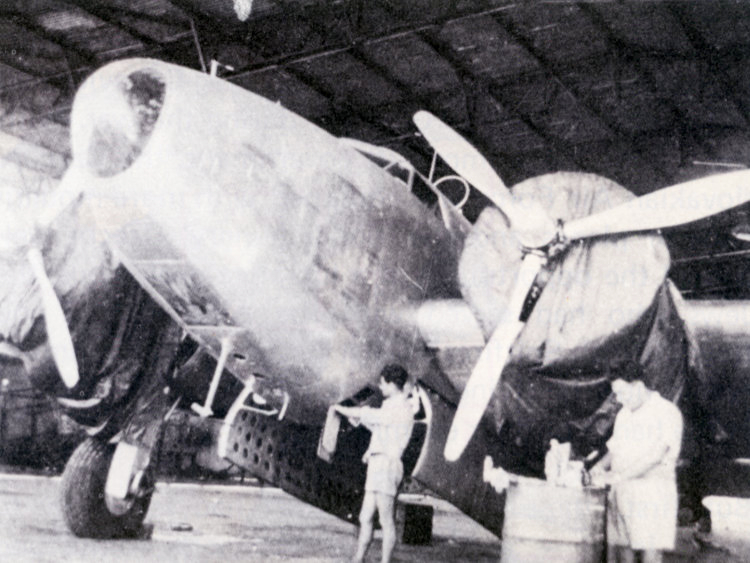
This photograph is reproduced from a magazine entitled Born in Battle (Issue 2) published in 1978 by Eshel-Dramit Ltd. of Israel. It is claimed that the photo was taken at Ekron Airbase. Although the magazine does not record an identity for the aeroplane, the original clearly shows that the aircraft has been fitted with a door on the port side of the nose compartment. This door is similar to those installed in other post-war Hudson civil conversions by Curtis Madsen Aircrafts at Bankstown, NSW. The open bomb bay doors, together with the nose transparency, suggest that the Hudson in the photograph may have been used as a bomber, in which case it is most likely ex VH-BIH which is believed to have been the only Hudson used by the IAF in a combat role. It is not known if VH-BIH was fitted with a baggage door in the nose, but we do know that VH-BIH was converted to an airliner with thirteen passenger seats so it is likely that it did have the baggage door in the nose. However, it is understood that the passenger seats were removed before the delivery flight to Israel. Although the engine covers make it difficult to determine which type of engine is installed, it is clear that there is no "bump" for the carburettor air intake at the top of the cowling so the engine cannot be a Wright R-1820 and must therefore be a Pratt & Whitney R-1830. As only one of the four Israeli Hudsons was fitted with Pratt & Whitney engines, the aircraft depicted above must be the former VH-BIH.
|
 |
|
|
|
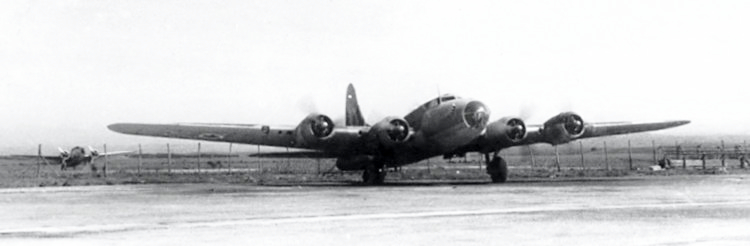
This 1948 photograph of an Israeli Air Force B-17 at an unknown location in Israel appears on page 99 of the book The Air Force in Battle - 70 Years of Aerial Superiority by Danny Shalom. The aircraft in the background at left (see cropped enlargement) is clearly a Hudson which appears to match the engine type, configuration and markings of the Hudson in the previous image which has been identified as the former VH-BIH. |
|
The
book The Air Force in Battle - 70 Years of Aerial Superiority
by Danny Shalom
|
 |
|
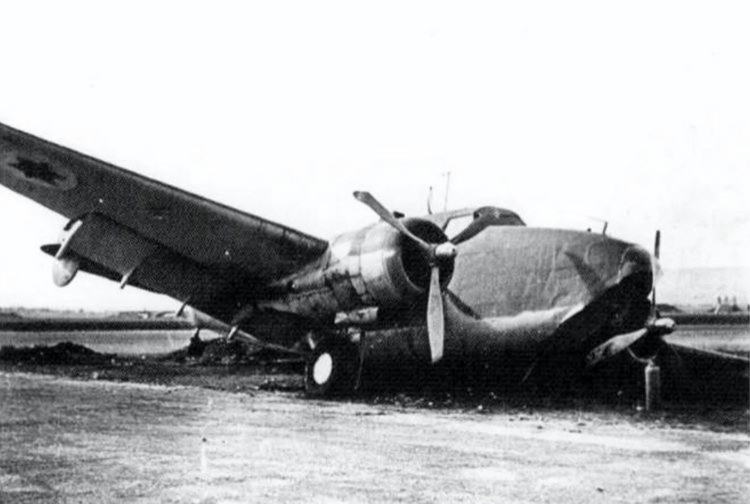
This
photograph appears on page 89 of the book The Israeli
Air Force Aircraft from the Tiger Moth to the Sufa by
Danny Shalom. It shows a damaged aircraft identified in
the caption as "Hudson 3". However, it has been
established that this is a mistaken identification of the
aircraft as a Hudson Mk III and not a reference to its IAF
serial number. This Hudson is camouflaged and carries an
Israeli roundel under the starboard wing. Although it appears
to have a transparent nose cone, the side windows in the
nose compartment appear to have been covered with fabric
and/or paint. As this Hudson clearly has Pratt & Whitney
engines, it can only be the former VH-BIH which was the
only one of the four Israeli Hudsons that had this type
of engine. |
|
The
book The Israeli Air Force Aircraft from the Tiger Moth
to the Sufa by Danny Shalom http://www.iaflibrary.org.il/Product.asp?ProdID=951
|
 |
|
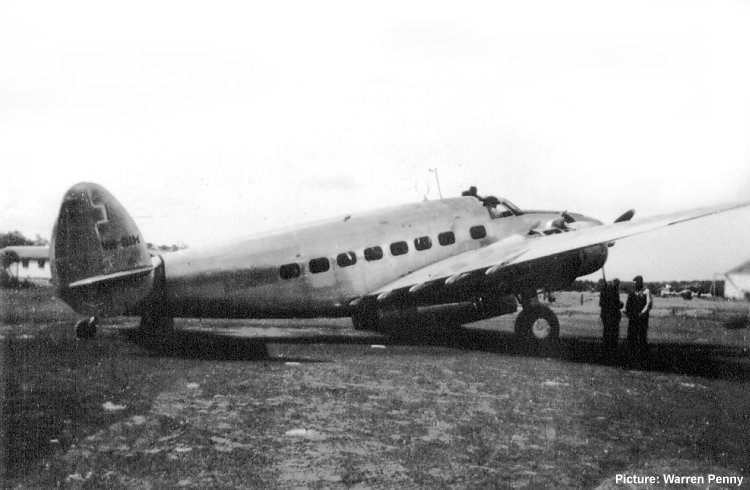
Identification of the Israeli Hudsons is made difficult by the lack of photographs of these aircraft in Australia. This photo of VH-BIH at Mascot is the only known image of an Israeli Hudson prior to departure from Australia. The Application for Registration for VH-BIH, dated 19 March 1948, stated that the aircraft was configured with 13 passenger seats but it is understood that the passenger seats were removed before the delivery flight to Israel. The DCA file on the aircraft later recorded that; "The registration letters painted on the side of the aircraft were about two inches high, presumably to avoid identification except at close quarters." The registration letters in the above photograph appear to be about half the height of the rudder balance weight cutout which has been measured (on an actual Hudson fin!) at 30cm (approx 12 inches) high so that would make the registration letters approximately 6 inches high. It could be speculated that the registration may have been moved subsequently from the fin to the "side" of the fuselage and in a reduced size but there is no evidence to support this. |
THE ISRAELI AIR FORCE TECHNICAL SCHOOL
|
The IAF Technical School featured in a 1951 film which can be viewed at this link: https://jfc.org.il/news_journal/27606-2/91855-2/ The following four images are screen grabs from this film.
|
 |
|
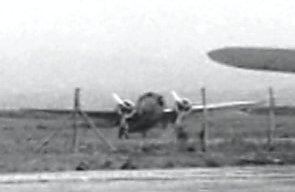
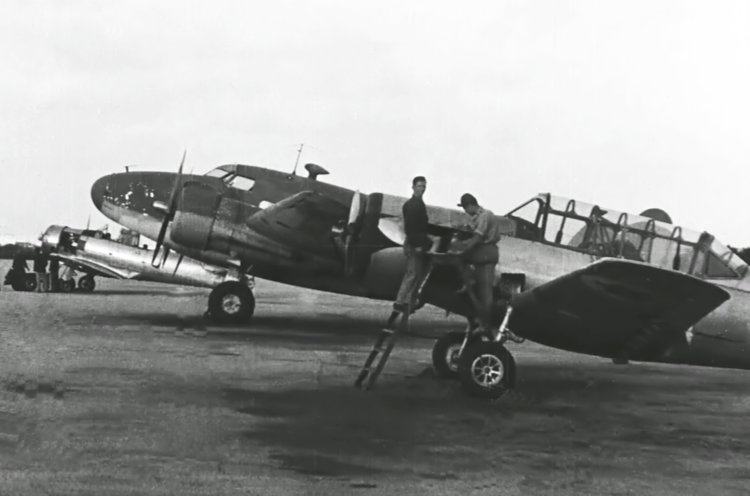
This Hudson Mk III appears at 1:37 in company with a T-6 and a BT-13. The Hudson has no nose windows so it was presumably used only as a transport. The aircraft is either VH-BFQ or VH-BIA or VH-BLB.
|
 |
|
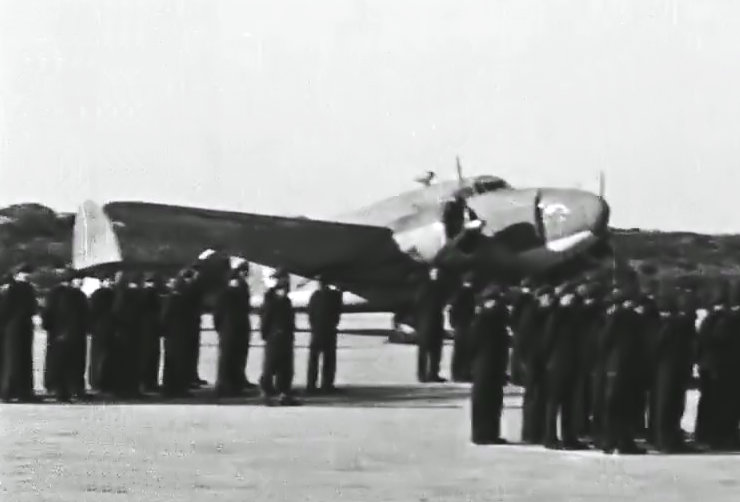
This Hudson Mk III appears at 1:58 and is probably the same aircraft as in the previous image. What appear to be markings on the nose in both images may be flaking paint or imperfections in the film. Unfortunately no serial number is visible.
|
 |
|
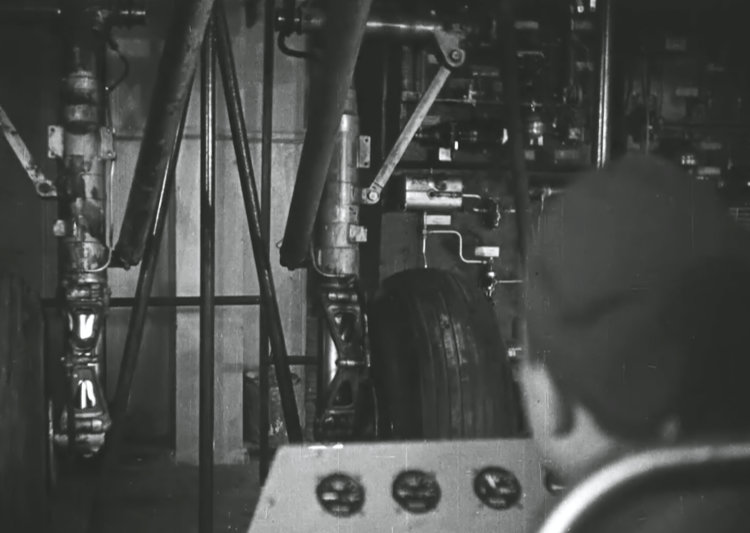
This image of an undercarriage retraction training aid appears at 1:03. It is seemingly a Hudson main landing gear and given that the film was produced in 1951 this unit could have come from the former VH-BIH which had been written off after a crash on 5 March 1949.
|
 |
|
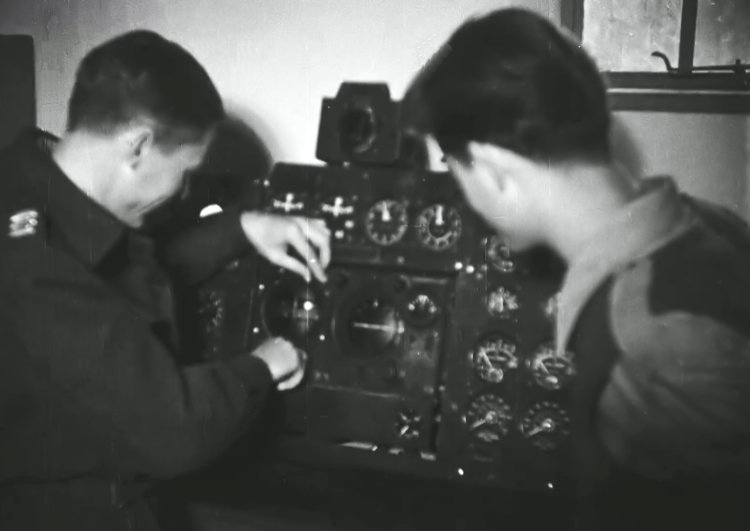
This image appears at 1:20 and seems to be a Hudson instrument panel which also may have come from the former VH-BIH which had been written off after a crash on 5 March 1949.
|
THE ISRAELI HUDSONS
Note: The Israeli serials shown in the following table are based
on delivery sequence and are subject to confirmation.
| Regn | Mk | MSN | Prev Owner | Depart Aust | Arrive Israel | Israeli Serial |
|---|---|---|---|---|---|---|
| VH-BIH | IV | 6076 | C.R. Penny | SEP48 | NOV48 | 2601 |
| VH-BFQ | III | 6417 | G. Marcel | FEB49* | FEB49 | 2602 |
| VH-BIA | III | 6477 | N. Marcello | FEB49* | FEB49 | 2603 |
| VH-BLB | III | 3843 | B. Thomas | FEB49 | MAY49 | 2604 |
* VH-BFQ and VH-BIA were delivered together, departing Australia on 13FEB49.
Swords into Ploughshares and back into Swords
|
In the
immediate post-war years, a number of operators sprang up
to serve the lucrative migration boom, principally from
Italy and Greece. Airlines such as European Air Transport
and Intercontinental Air Tours plus a number of individual
entrepreneurs were quick to recognise the suitability of
the Hudson which was comparatively plentiful and cheap when
compared with more desirable types such as the DC-3. Although
European Air Transport purchased seven Hudsons post-war,
only two (VH-BFQ & VH-BIA) found their way on to the migrant
run. The conversion of a third Hudson (VH-BIB) was abandoned
and the aircraft scrapped, along with the other four unconverted
Hudsons. The Hudson's participation in the migrant trade
was comparatively short-lived and most of the operators
involved soon found themselves in financial difficulties
with the Hudsons being their most significant assets. At
this time, the struggle for an independent Jewish state
had led to hostilities in Palestine. Australia joined with
many other nations in introducing embargoes against the
new state. As a consequence, Israel had to scour the world
for whatever aircraft it could acquire and it wasn't long
before the Australian Hudsons came to their attention. In
all, four Australian Hudsons found their way to the Israeli
Air Force. These illegal exports invariably commenced with
a notification to the Department of Civil Aviation that
the aircraft owner was planning to take his aircraft overseas
on a private or charter flight. Subsequently the aircraft
were diverted to Israel and handed over to the Air Force.
As these four Hudsons had been civilianised, it was not
until late December 1948 that the first Hudson saw action
in the bombing role. It is understood that only the first
Hudson (ex VH-BIH) actually entered service as a bomber
while the other three Hudsons served as transports with
Air Transport Command at Ekron. Subsequently they were assigned
to 106 Squadron. In May 1949, 106 Squadron disbanded and
the Hudsons were transferred to 103 Squadron. Three Hudsons
were still on strength to 103 Squadron at 1st January 1950
and these aircraft may have remained in service until as
late as 1954.
|
|
Issue
|
Date
|
Remarks
|
|---|---|---|
|
6
|
22DEC22
|
It
has been established that VH-BFQ and VH-BIA were delivered
together.
|
|
5
|
02DEC22
|
Added
a link to a film about the IAF Technical School thanks
to Yehonatan Last.
|
|
4
|
06NOV22
|
Added
two images thanks to Yehonatan Last and the sources shown.
|
|
3
|
08JUN98
|
-
|
Return to the Hudson Menu

Return to The Lockheed File